I’m proposing a different weapon in the designer’s arsenal – a solution to the problem of pointless collection and endless browsing. To explain the problem and the weapon, I will use the work of Gilles Deleuze, Felix Guattari, Niklas Luhmann, and Roland Barthes.
Architecture, like any other art form, is intertextual: a building does not stand alone and is not experienced as separate (Kristeva, 1982, p. 66). It does not arise out of the pure creativity of the author: analogous to a text, a building is not like “a line of words releasing a Single “theological” meaning (the “message” of the Author-God) but a multi-dimensional space in which a variety of writings, none of them original, blend and clash” (Barthes, 1977, p. 146). Each of its elements has precedents. Its form is a copy. Its function is nothing new. Its context is all too familiar.
While this may be obvious, most architects try to escape this inescapable bind. They try to make their buildings stand out for the sake of standing out. They fertilize them with symbols, fatten them with useless originality, only to get a chimera of copies, since “all this creative power of the mind amounts to no more than the faculty of compounding, transposing, augmenting, or diminishing the materials afforded us by the senses and experience” (Hume, 1748/1907, p. 16).
I’m proposing the opposite. Let us embrace this bind rather than fight it. Why not distill what gets copied, what repeats, and what finds a use half-irrespective of the situation? We do this already when we save different architectural projects, look for inspirations on social media, try to find what to mimic from a famous work, write down a specific regulation we don’t want to forget, etc. So the question is not of general value. The question is how to make this process more (un)systematic.
Enter the rhizome: “Subtract the unique from the multiplicity to be constituted; write at n – 1 dimensions. A system of this kind could be called a rhizome. A rhizome as subterranean stem is absolutely different from roots and radicles. Bulbs and tubers are rhizomes. Plants with roots or radicles may be rhizomorphic in other respects altogether: the question is whether plant life in its specificity is not entirely rhizomatic. Even some animals are, in their pack form. Rats are rhizomes. Burrows are too, in all of their functions of shelter, supply, movement, evasion, and breakout. The rhizome itself assumes very diverse forms, from ramified surface extension in all directions to concretion into bulbs and tubers. When rats swarm over each other. The rhizome includes the best and the worst: potato and couchgrass, or the weed. Animal and plant, couchgrass is crabgrass” (Deleuze & Guattari, 2003, pp. 6-7).
To understand the rhizome, we must explain its binary – we must explain what it contrasts with. The two main differentiating characteristics of a rhizome are (1) connection and (2) heterogeneity: “any point of a rhizome can be connected to anything other, and must be. This is very different from the tree or root, which plots a point, fixes an order” (Deleuze & Guattari, 2003, p. 7). The rhizomatic structure stands in sharp contrast to an arborescent one. A tree, for instance, has a hierarchical body: there is a clear order and rule according to which a specific part of a tree connects to another. Much philosophical thinking procedes in the same manner, but as in a philosophical work, so in a design archive, we may opt for Adorno’s formula: “In a philosophical text all the propositions ought to be equally close to the centre” (Adorno, 2005, p. 62).
A hierarchical structure has an order before the elements are collected. The author imposes an artificial and readymade system that filters the parts into different enclosures. All the “inspiration” material for building exterior design goes into one space; all fire safety principles go into another. The problem is that this type of system cannot communicate with its author – it cannot surprise you.
By contrast, a more fluid structure can give rise to new information through unexpected connections: “It is impossible to think without writing; at least it is impossible in any sophisticated or networked (anschlußfähig) fashion. Somehow we must mark differences, and capture distinctions which are either implicitly or explicitly contained in concepts. Only if we have secured in this way the constancy of the schema that produces information, can the consistency of the subsequent processes of processing information be guaranteed. And if one has to write anyway, it is useful to take advantage of this activity in order to create in the system of notes a competent partner of communication. […] If a communicative system is to hold together for a longer period, we must choose either the rout of highly technical specialization or that of incorporating randomness and information generated ad hoc. Applied to collections of notes, we can choose the route of thematic specialization […] or we can choose the route of an open organization” (Luhmann, 1992, pp. 53-61).
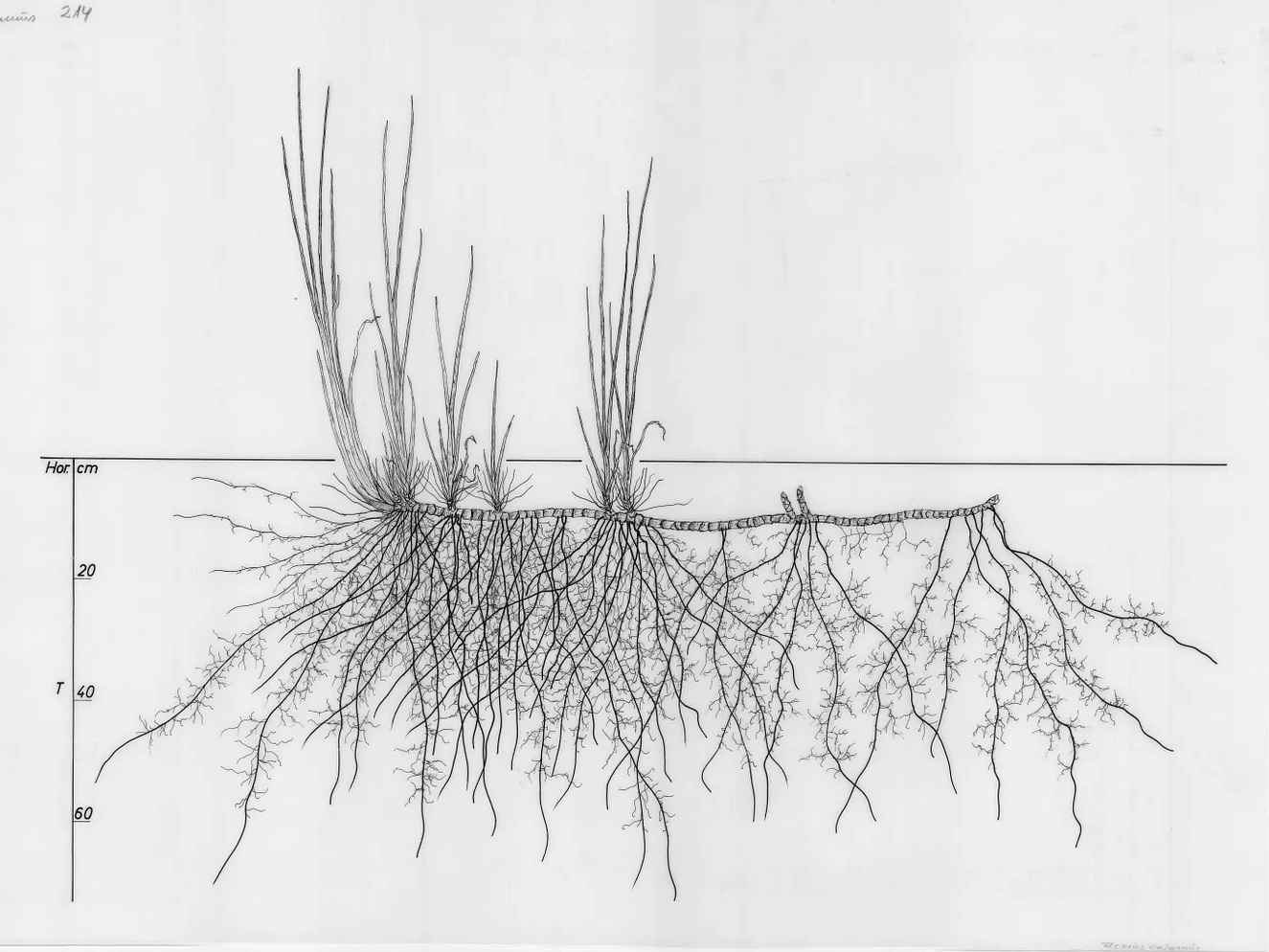
Like crabgrass, any node of a rhizomatic archive can expand upwards. The non-hierarchical structure does not dictate the places of expansion and decay; they instead arise out of necessity at any given time and place. Any part of the archive has the potential to grow, to intensify, irrespective of its preconceived importance.
A horizontal, rhizomatic structure of grass that can grow vertically at any point.
Connection and heterogeneity are the primary characteristics I demand of a design archive. The archive can be physical or digital, singular or dispersed, but chaos must engulf it: a principle for arranging duplexes in an apartment building stands next to a specific design for the first step of a staircase; data on the relative dangerousness of one-way streets follows the phenomenological exploration of shadows in Japanese architecture.
In concrete terms, let’s imagine this rhizome as a physical notebook. Each principle/element/note has a unique identifying number. The final page has a table of contents that starts from the bottom and is written in reverse. The notes have other numbers listed on the bottom, signifying the related elements. Once the notes meet the table of contents, the notebook ends, and another begins. So, one may suddenly see, for instance, the connection between a specific approach to the placement of trees near streets and the arrangement of shading elements in an open corridor.
The proposed alternative to endless browsing and collection of material in an arborescent manner, then, is a rhizomatic collection of disparate but densely linked elements. One does not worry about order, one lets the machine operate, one forgets its mechanism, and the structure arises in medias res.
References
Adorno, T. (2005). Minima Moralia: Reflections from Damaged Life. Verso.
Barthes, R. (1977). Image, Music, Text. Fontana.
Deleuze, G., & Guattari, F. (2003). A Thousand Plateaus: Capitalism and Schizophrenia. Continuum.
Hume, D. (1907). An enquiry concerning human understanding; and Selections from a treatise of human nature. La Salle, Ill. Open Court Pub. Co. (Original work published 1748)
Kristeva, J. (1982). Desire in Language: A Semiotic Approach to Literature and Art. Columbia University Press. p. 66.
Luhmann, N. Kommunikation mit Zettelkästen. Ein Erfahrungsbericht. in. André Kieserling (1992). Universität als Milieu. Kleine Schriften. Haux. Bielefeld. pp. 53-61.
Let no thought pass incognito, and keep your notebook as strictly as the authorities keep their register of aliens. (Benjamin, 1928/2016, p. 46)
For as long as I can remember, I’ve been obsessed with systems that can help me think. Even my desire to write is downstream of my desire to understand. I’m afraid of forgetting, so I keep switching and inventing new systems for taking notes. My long-term memory is pretty good, but I still need an external system that collects my thoughts and lets me communicate with them. So does almost everyone else: “I started the index card file for the simple reason that I have a poor memory” (Luhmann, 1987, p. 149). Taking notes is a way to transfer the burden of remembrance from your brain to something else. Writing something down gives a sense of security—Lethe is no longer threatening. You have no reason to trust your memory. Your working memory could be the best in the world, yet that still wouldn’t be good enough. Any effective system for taking notes should allow you to forget about forgetting. So here I want to lay out mine. I want to specify why I chose this system and why you may wish to apply it.
The practice of taking notes has a long history. Many prominent writers, philosophers, and scientists have their methods. Gottfried Wilhelm Leibniz, Georg Philipp Harsdörffer, Niklas Luhmann, Claude Lévi-Strauss, Roland Barthes, Vladimir Nabokov, Georg Wilhelm Friedrich Hegel, Walter Benjamin, Reinhart Koselleck, Paul Valéry, Heinrich Heine, Arno Schmidt, Jean Paul, and Ernst Jünger just to name a few. Would their accomplishments be the same without their collections of notes? If not, how come none of them realized they were wasting their time? Luhmann, for example, managed to produce over 50 books and 550 articles during his lifetime because of his sophisticated system for taking notes (Schmidt, 2016, p. 289). The systems differ. No system is perfect for everyone at all times. I know this well, yet the thought that my system could be just a bit better never abandons me.
I often buy notebooks and soon stop using them for the most superficial reasons. I obsess over the formatting of each and every note. I dismiss entire notebooks because of a small mistake. I download new note-taking apps and try them out, only to stop using them after a month or two. I’m never satisfied with my tools. I’m never really calm. I’m terrified of becoming so obsessed with productivity and finding the ‘perfect system’ that this inhibits rather than helps me think. I see all this as a problem I need to fix. If any of this applies to you, I hope this essay serves you well.
I will do the following: First, I will discuss why you might want to write notes. Then I will briefly outline the history of note-taking. Specifically, I will consider hypomnema, commonplace books, journals, Paul Valéry’s Cahiers, and Niklas Luhmann’s Zettelkasten. I will then outline how I intend to take notes, at least for the conceivable future. I hope to encourage you to start taking notes more seriously. I also want to force myself to stick with one of the methods I discuss here. Essentially, this essay is a form of “working with the garage door up“: I will write about my problems and try to work through them openly.
In his famous essay, Kommunikation mit Zettelkästen, Niklas Luhmann posits that it is impossible to think in a sophisticated or networked way without writing (Luhmann, 1992, pp. 53-61). Is he right? Could, for example, Grigori Perelman have proved the Poincaré conjecture all in his head? Could James Joyce have written Ulysses linearly in one go? Could Shakespeare have written his 154 sonnets without any editing or modifications? I think not. What Luhmann means by “sophisticated thinking” is the type of thinking required for the complex synthesis of previously unrelated material. Synthesizing diverse material through writing notes is a form of intellectual labor.
If you want to retain the intellectual labor you’ve already done and increase its quality—you must write. You must write to protect yourself from forgetfulness. You must write to think. You must write now so that you may write more later. Writing accretes. Your collection of notes becomes your communication partner. If you want to figure something out and can’t succeed through thinking independently, you should speak about it with someone (von Kleist, 1805/2001, p. 319). That ‘someone’ may be the previous you. The previous you that made all those notes so many years ago. You may have forgotten, but the ink is still there. When one writes, one reads what one has written. The letters act upon their author right when they are born, just as they act upon anyone who reads them later. In time, notes become sovereign machines capable of influencing their readers.
Any practice or idea that has lasted millennia has a good chance of being useful. Lasting for long is proof of usefulness. Concepts go through the process of natural selection. Time obliterates all that is useless. We should, therefore, expect that note-taking will have many precedents that stretch for thousands of years. This is exactly what we find. Even Leibniz, Harsdörffer, Heine, and Hegel are relatively recent examples. Countermeasures against forgetfulness have their roots in ancient Greece. Plato’s criticisms of writing in the Phaedrus rely on the idea that writing discourages the use of memory. That instead of an elixir of memory, writing is an elixir of reminding (Plato, Phaedrus, 275a).
There also existed a practice of writing what the Greeks called hypomnemata. These books, notebooks, or notes were not substitutes for memory. They were not narratives of oneself or intimate journals. They intended to capture what was already said (Foucault, 2005, p. 500). To collect what one heard, read, or came up with (Foucault, 1997, pp. 210-211). Hypomnemata made possible the establishment of a “relationship of oneself with oneself” by making one’s recollection of the fragmentary λόγος readily available.
Seneca stressed the importance of keeping a treasure store of reading. According to Seneca, going from book to book and not writing anything down puts one in danger of retaining nothing and forgetting oneself (Seneca the Younger, Epistles, p. 7). The writing process counteracts stultitia, i.e., mental agitation, distraction, and constant wavering between opinions. Reading for nourishing and refreshing the intellect and writing for fixing ideas are both essential (Seneca the Younger, Epistles, p. 277). Hypomnemata allow the psyche to detach itself from concerns about the future and direct itself toward the past.
The issue with hypomnemata or notebooks is that they are collections of heterogeneous fragments. The writer must establish links, similarities, and differences between them. Most notebooks are unfinished, underused, chaotic, and fragmented. For these notebooks to be helpful, it is necessary to organize and index them.
Let us take down one of those old notebooks which we have all, at one time or another, had a passion for beginning. Most of the pages are blank, it is true; but at the beginning we shall find a certain number very beautifully covered with a strikingly legible hand-writing. Here we have written down the names of great writers in their order of merit; here we have copied out fine passages from the classics; here are lists of books to be read; and here, most interesting of all, lists of books that have actually been read, as the reader testifies with some youthful vanity by a dash of red ink. (Woolf, 1958, p. 25)
Seneca had a solution. It was to run everything we have absorbed through our lens. To digest all thoughts gathered from reading. To put in all hypomnemata a unifying element: us. Only in this way will the material enter our reasoning rather than exclusively our memory. Other writers, for example, Umberto Eco, have stressed a similar point (Eco, 1977/2015, pp. 164-167). It is vital to write in your own words. To paraphrase rather than quote. Direct quotations don’t demonstrate how you understand what you’re quoting. Paraphrasing, by contrast, always involves interpretation. It transforms the original material into “tissue and blood” (Seneca the Younger, Epistles, p. 281). Interpretation is a transformative and creative act. The more effort one puts into thinking an idea through, the sharper it seems. I write ‘seems’ because whether or not it sharpens is a matter of debate. The important part is that you become more confident in your writing.
There are, of course, exceptions to this rule. Sometimes you want to analyze a poem. Paraphrasing it is almost always a bad idea. Sometimes you want to dissect how the author uses language in a given passage. Or the language is so powerful that you do not wish to change anything. Sometimes your interpretation is not as important because the meaning is unambiguous. Consider, for example, Shakespeare’s 7th sonnet (1609/1923):
Lo, in the orient when the gracious light Lifts up his burning head, each under eye Doth homage to his new-appearing sight, Serving with looks his sacred majesty; And having climb’d the steep-up heavenly hill, Resembling strong youth in his middle age, Yet mortal looks adore his beauty still, Attending on his golden pilgrimage; But when from highmost pitch, with weary car, Like feeble age, he reeleth from the day, The eyes, ’fore duteous, now converted are From his low tract and look another way: So thou, thyself out-going in thy noon, Unlook’d on diest, unless thou get a son.
If I had the choice of paraphrasing or directly quoting the passage above, I think it’s clear why I would choose the latter. The language gives it more value than any interpretation could. I could paraphrase just the meaning, but so much would get lost. The reader wouldn’t see that although Shakespeare uses many metaphors to describe the sun, the word itself never comes up. And the sonnet, when you’re not expecting, ends with the word son. This and other such ingenuities would all get lost. Analyzing the way Shakespeare uses language in this sonnet would require a lot of work and would be a more worthy endeavor.
In producing art of any kind, be it writing, painting, or architecture, I find that the more effort I put into something, the more proud I am. If I don’t spend much time on, for example, an architectural project, I will inevitably think it’s not good enough. When people say that a lot of work went into creating an art piece, they usually mean it as a compliment. As if the work that went into creating something gives it more value (Zumthor, 1998/2010, p. 12). Whether or not this is true, it certainly seems like it is. And it is, therefore, worth it for me to spend more time with each note. Hence my preference for writing by hand before moving to a computer. It gives them more value.
I won’t exhaust the comparison of digital vs. analog tools for taking notes. You probably know most of the pros and cons of each already. I could cite research on how writing things down by hand makes it more likely for you to remember them or how reading on paper rather than on a screen has the same effect. I could discuss how digital notes have the advantage of being easily searchable. I could claim that you might not want to rely on a specific app or company to store all your writings. That discussion deserves a separate essay, but there isn’t much I can add that hasn’t already been said a thousand times. I think it ultimately boils down to personal preference. I use both.
So how do we organize our hypomnemata? With commonplace books like John Locke, John Milton, Francis Bacon, Ralph Waldo Emerson, and Henry David Thoreau? With notebooks like Friedrich Nietzsche, Martin Heidegger, Virginia Woolf, Walter Benjamin, and Paul Valéry? With slip boxes like Gottfried Wilhelm Leibniz, Vladimir Nabokov, Roland Barthes, Claude Lévi-Strauss, and Niklas Luhmann? The way I currently organize my notes is a combination of these, so I will explain what each means in turn.
Let’s begin with commonplace books. Commonplace books are notebooks used for collecting notes about books, articles, journals, and other media. “In their purest form, commonplace books were written in Latin by schoolboys who organized sententiae under topic headings” (Burke, 2013). They differ from diaries or writer’s journals because they are generally not introspective or chronological (Basbanes, 2006, p. 82). My issue with exclusively relying on commonplace books is that my ideas have to get mixed with reading notes, and I think those two deserve their own spaces. If you want to find some idea and the only thing you use is a commonplace book, you must remember what you were reading when that idea came to you to find it. And I don’t want that. I want to be able to find any note based on its address.
Reflective notebooks, like Nietzsche’s notebooks (Nietzsche, 2003 & Nietzsche, 2009), differ from commonplace books because you don’t fill them with notes about the books you’ve read. You fill your reflective notebooks with the ideas you develop. Paul Valéry, for example, devoted the early hours of each morning to writing in his Cahiers (Lawler, 1976, p. 346). I prefer combining this with a commonplace book. I split my notebooks in half: I use the first half for my ideas and the second half for reading notes. These two correspond to different types of slip cards in Niklas Luhmann’s system.
Now I will explain what the zettelkasten is. A zettelkasten (slip box) or card file consists of small paper slips arranged in an organic network and linked to one another. Many writers use slip cards to help them write, but I won’t explain each method separately. I believe Niklas Luhmann brought everything useful about a zettelkasten to near perfection. I will, therefore, focus only on that.
When working on his dissertation, Luhmann realized that the notes he took would be useful not just for one book but for a lifetime (Luhmann, 1987, p. 149). Filling the zettelkasten took more of his time than the writing process itself (Luhmann, 1987, p. 142). Yet the results speak for themselves: it was worth it. The card index helped rather than held back Luhmann from writing so much.
Although surprising for such a systematic thinker, Luhmann didn’t pedantically adhere to specific types of ink or paper. He used A6 size paper, but the backside was sometimes already written. He took some notes with a blue pen and some with a red one. Some are on thick paper, some on thin, and so on (Schmidt, 2016, p. 291). I wish I could do this too, but it bothers me too much. Maybe after some inconsistencies, one gets used to them. I hope I will too. Luhmann used these slips of paper to record all kinds of information: his theses and concepts, reading notes, questions, and bibliographical information.
He had three types of cards. We may call them permanent, bibliographic, and index cards. Permanent notes contained distilled ideas. Bibliographic cards contained brief reading notes. Index cards contained lists of keywords with several addresses per keyword. What are addresses? Since Luhman was using pen and paper, he had to find a way to find the slip cards whenever he wanted. So he would give an alpha-numeric address to each slip. Card 9 would go between cards 8 and 10. If Luhmann wanted to put a new card between cards 9 and 10, he would give it the address 9a. If he wanted to put a card between 9a and 10, he would give it the address 9a1, and so on. I prefer using a physical notebook for ephemeral notes and bibliographic cards, and I use my computer for permanent notes. I find physical index cards to be limiting, and I prefer carrying around a notebook to carrying around a bunch of A6 papers.
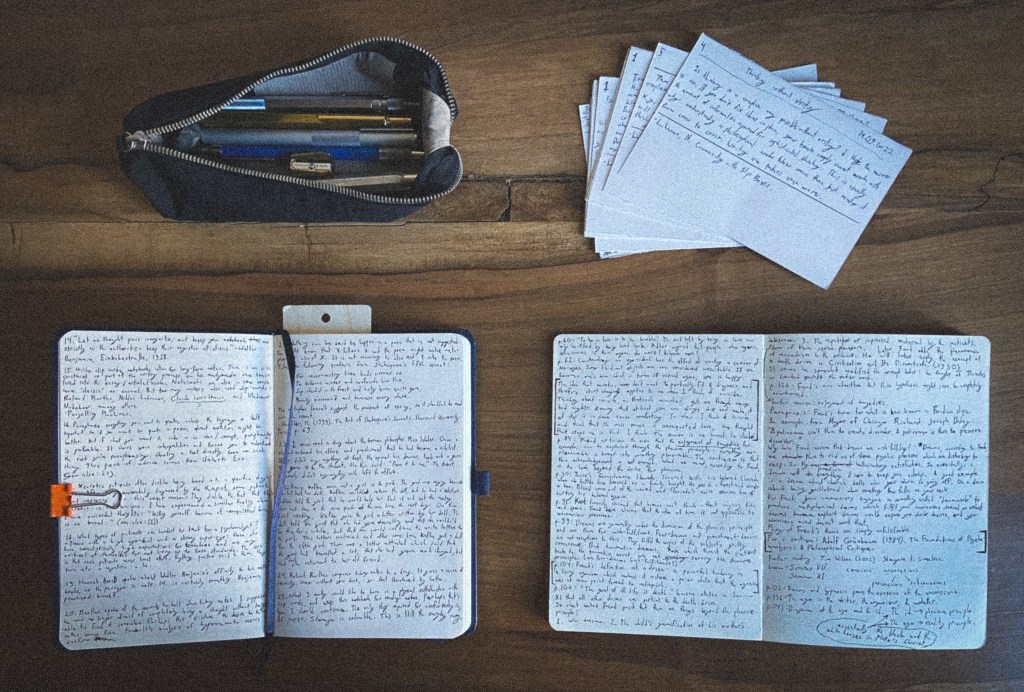
So my system consists of two things: a notebook for reading and ephemeral notes and a folder on my computer for my permanent notes. The reasons I keep a physical notebook are as follows: (1) writing things down makes you remember them, (2) a notebook is more portable than a laptop, (3) I don’t have to worry about formatting, searchability, etc., (4) writing by hand forces you to make your notes more concise, (5) I don’t get distracted by a computer while reading, and (6) aesthetics.
The reasons I prefer to have my permanent notes on my computer are as follows: (1) it is easier to lose pieces of paper than files if you use external drives, (2) I can copy the already written text directly, (3) I can copy citations which I have already generated, (4) I can edit the permanent notes if I have to, (5) I can search the notes, so there is no need for physical index cards, (6) There is no length limit to any single note, and (7) digital notes are more portable. The software doesn’t matter much.
We began with a discussion of the history of fighting forgetfulness. Note-taking has a surprisingly long history: even the ancient Romans have much to say about it. We saw different methodologies for taking notes and arrived at my system. I tried to give reasons for choosing this system, but I admit that this subject gives me a lot of trouble. I’m not firm in my convictions. I hope this was useful for you too.
references
Basbanes, N. A. (2006). Every book its reader: The power of the written word to stir the world. Perennial.
Benjamin, W. (2016). One Way Street. Harvard University Press. (Original work published 1928)
Eco, U. (2015). How to Write a Thesis. The MIT Press. (Original work published 1977)
Foucault, M. (1997). Ethics: Subjectivity and Truth. New Press.
Foucault, M. (2005). The Hermeneutics of the Subject: Lectures at the Collège de France 1981–1982. Pan Macmillan.
Krajewski, M. (2011). Paper Machines: About Cards & Catalogs, 1548-1929. The MIT Press.
Krajewski, M. (2016). Note-Keeping: History, Theory, Practice of a Counter-Measurement Against Forgetting. In Cevolini, A. Forgetting Machines: Knowledge Management Evolution in Early Modern Europe. BRILL.
Luhmann, N. (1987). Biographie, Attitüden, Zettelkasten. In Luhmann, N. Archimedes und wir. Interviews. Merve Verlag. pp. 125–155.
Luhmann, N. (1992). Universität als Milieu: Kleine Schriften. Haux.
Nietzsche, F. W. (2003). Writings from the Late Notebooks. Cambridge University Press.
Nietzsche, F. W. (2009). Writings from the Early Notebooks. Cambridge University Press.
Plato. Phaedrus.
Schmidt, J. F. K. (2016). Niklas Luhmann’s Card Index: Thinking Tool, Communication Partner, Publication Machine. In Cevolini, A. Forgetting Machines: Knowledge Management Evolution in Early Modern Europe. BRILL.


 Tio Gabunia